

More than just Mona!
Updated: Apr 5
Next month Christine and I will visit Paris together for the first time since she was pregnant with Jackson! (27 years ago.) For some reason she's got the idea that visiting the Louvre' is unnecessary and "too time consuming" for fitting into the three days we'll be there this time. This is wildly incorrect of course.
One must ALWAYS 'check-in' with the Louvre when in Paris!
So, as a service for 'Tulipino mio'...I will set out here to remind her of a few of the friends I must spend time with during this new visit.
Enjoy.
Most museum visits for me start with an internal list of objectives divided into 'highest priority targets'.
I missed 'Laocoon and his sons' at the Vatican museum 4 years ago....The embarrassment and shame from this absurd fumble stayed with me for two years, before I could get back there and rectify it.
This visit at the Louvre', my main, can't-miss piece is one that I simply forgot to find last time I was there! It's The painted limestone, ancient Egyptian sculpture titled, "Seated Scribe".


The 'Scribe' is a masterpiece of ancient Egyptian art from the Old Kingdom 2600–2350 BC.
Discovered in 1850 the paint- ed, limestone statue is cele-brated for its startling realism, which contrasts with the more idealized depictions of pharaohs from the same era.
The Scribe's most famous feature is its extraordinarily lifelike eyes, crafted from red-veined white magnesite and inlaid with polished rock crystal pupils held in place by copper clips. The scribe is depicted in a cross-legged working posture with a papyrus scroll across his lap, while his hands are poised as if holding a now-lost reed brush. Although his exact identity remains a mystery, his refined features and slightly soft physique suggest he was a high-ranking official or possibly royalty, reflecting the elite status of literate individuals in ancient Egyptian society. Can't wait to see this gentleman.


Next: Probably the work in the louvre' which I have spent the most time standing before and studying, is Theodore Gericault's 'The Raft of the Medusa'. I expect again to have that pleasure this coming May.

Super brief, AI-composed explanation of Gericault's opus work:
"In 1816, the French frigate Méduse ran aground off Mauritania due to an incompetent captain’s errors. With few lifeboats, 147 people were abandoned on a makeshift wooden raft.
The next 13 days were a descent into hell. Starvation, dehydration, and brutal mutinies decimated the group. To survive, some resorted to cannibalism. When the Argus finally rescued them, only 15 men remained alive.
The scandal outraged France, exposing government corruption. Artist Théodore Géricault immortalized the horror in his masterpiece, The Raft of the Medusa, capturing the moment hope appeared on the horizon amidst utter despair." I have read a book on the subject (below), which I thought was really well written. It told its story from the alternating points of view of, Gericault's time studying researching and finally painting his greatest work AND the actual events of the wreck, as recorded from court testimony and interviews of actual 'veterans' of the raft experience. The entire event and the history of its resulting trials are fascinating and a MAJOR event in French history.
The degree to which this work defined Gericault for Parisians is apparent in the grave marker they chose for him. (Below, R.)

Next, 'gotta-see-every-time' work in the louvre' for me is Jaque Loius David's, 'the Coronation of Napoleon'. Here is a perfect photo for showing the crazy SIZE of this great masterpiece.

Here're some details.

Jacques Louis David is also an interesting character for reasons widely separated from his masterful art. He was also quite 'political' and aligned closely with Robespierre, Marat and Danton etc. during the fiery height of the French revolution....But he also had a long, remarkable connection to Napoleon, who was a close confidant of David's, even as a young lieutenant in the French army. Here is another favorite piece to see in the louvre'....David's incomplete portrait of young Napoleon Bonaparte (below, left)...along with the artist's own selfie as a young man. At lower right is perhaps David's greatest work, "the Death of Marat"...a studio copy of which exists at the louvre'...but the original piece hangs today at the 'Museum of fine arts of Belgium'...probably because soon after painting it, David was EXCILED to Belgium after Napoleon's fall and the Bourbon, Royal restoration.

Next stop:
'Winged Victory of Samothrace'....also titled, 'Nike of Samothrace'...is a 2nd century BC, Hellenistic votive monument discovered by French officials at Samothrace, an isle in the northeastern Aegean sea in 1860.
Nike has stood at the top of the main staircase within the Louvre since soon after its re-discovery. Here is a photo of the heart-stopping view of Nike from the bottom of those steps which has charmed visitors to the louvre' since 1884.

Here are three views of Nike...two of which I photo'd myself. The view on the left shows some of the remarkable detail, characteristic of Greek Hellenistic Sculpture...The center illustration shows a likely full presentation of the piece in ancient times and the Photo to the right is my favorite. When visiting Nike, take a moment to locate a small sign near the top of the stairs on the right side as you look at the larger top photo above. I photographed the Nike on the right (below) from a spot suggested by the sign which identifies that position as 'showcasing the sculpture as it was designed: Rising above the viewer at the top of the grand stairway, emphasizing its motion and making it appear as if about to take flight'. (Looking for this sign was a suggestion to me from my sister Paddy before a visit in 2019!)

Next is a piece I knew nothing about, previous to my last visit to the louvre'. This is an actual 'interior column capitol' from the famous palace of Persepolis, at the ancient seat of power of the great Persian Empire near present-day Shiraz, Iran.
Note that the inset below is an artist's rendering, showing a similar column and capitol in position within the palace.

Persepolis was a magnificent palace built by the legendary Persian King, Darius I (first son of Persia's well-known previous ruler, Xerses) around 500 BC.
Some 200 years later, Darius III lost control of Persepolis to Alexander the Great, whose comparably TINY army quickly out maneuvered Darius III and took both the Palace AND Darius' ARMY from him as well!
Here below is a famous fresco'd mural discovered at Pompeii which shows portraits of Alexander and Darius III at that fateful battle!

Obviously, my favorite part of this story is that on an early night as 'homeowner' at his newly acquired 'greatest palace in the world'...Alexander and his cronies held what must have been an EPIC 'symposium', which resulted in their drunkenly deciding to burn-down the famous palace. Historians Diodoris and Plutarch EACH record that a very DRUNK Alexander was first to 'throw a torch' into the palace through it's magnificent doors. His act was then repeated by equally soused guests and soldiers, who then raucously burned the palace to ashes. Here's an historical renderer's educated work showing the interior of the fabulous palace...

Following now are several pieces I know and love at the louvre' and I look forward to 'checking in with' when honored to visit again in May! Let's start with the paintings:
Any work by Caravaggio has captured my heart since first learning of his work as a kid. There are three of Michelangelo Caravaggio's works in the louvre and they're all magnificent. They are; 'The Fortune Teller', 'The Death of the Virgin, and 'the Portrait of Alof d' Wignacourt'. Here they are below...

The Fortune Teller is one I really love...perhaps for a selfish reason. I have always laughed a bit at the fervor among louvre'-visitors to rush through Western art's high Cathedral just to get a fleeting look at Leonardo's 'Mona Lisa' or l'Gicande as the French say. Caravaggio's gorgeous Fortune Teller conversely, is in the next sala from Mona...Literally about 100 feet away from the panting, shoving, camera-wielding throng viewing Mona from a distance and between the heads of the viewers between the work and themselves....And NOBODY is EVER standing in front of this clearly SUPERIOR work of Mr. Caravaggio.
The Death of the Virgin and the Wignacourt are each spectacular examples of Caravaggio's mastery of 'Chiaroscuro'...the dramatic high value, high contrast compositions which have most closely characterized this master's wonderful work.
Another such 'must see' painting for me is "the Cheat with the Ace of Diamonds"

Maybe I like this one because it seems so unlike the 'usually more serious' compositions of the louvre' works. The artist is the Frenchman George de la Tour in the year 1635.
Here are 3 greats from Eugene Delacroix...who is for me, kind of like 'the French, Diego Rivera'. Same kind of passion, same kind of 'heroic models'.

The pieces above are, from left: 'Liberty Leading the People", "the Death of Sardnapalus" and "Women of Algiers in their Apartment". I don't know if I LOVE any of them...but I will say that they are so fun to observe in person. Every part of each of these pieces is just SO flawlessly executed...seeing them up close is SO inspirational.
NEXT...once again, Busts are interesting to me (get over it)...here are a bunch of GREAT ones in the louvre' collection....


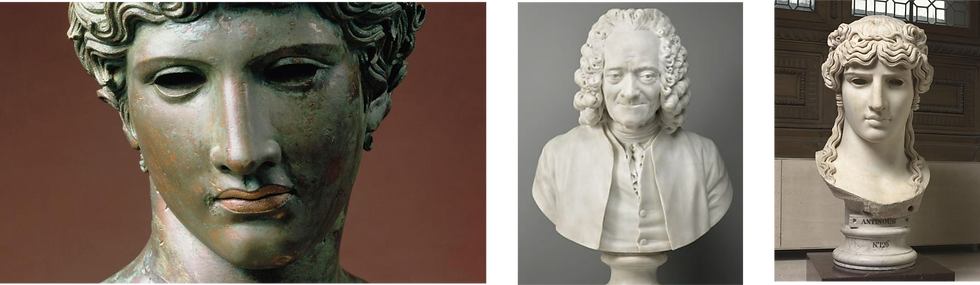
Yeah, I know that's not a BUST of Caesar....But this is MY blog. OK...that's it for this entry.
Suffice to say I AM visiting the louvre' this visit in Paris for at least a few hours...with or without my beloved Christine....and I even 'commissioned' this AI poem for the event! (I only read the first line, myself...) You’ve got the wine, you’ve got the bread,
But leave that beret on your head!
There’s one big shed you must explore,
Even if your feet are sore.
You go to see the Mona Lisa,
Smaller than a slice of pizza.
Is she smiling? Is she bored?
Or just wondering if she's insured?
You’ll walk ten miles through marble halls,
Ignoring all the exit calls,
To see a Venus with no arms,
Who still has quite a lot of charms.
Why go again? The reason’s clear:
You haven’t seen it all this year.
Plus, if you skip it, it’s a sin—
And where else can you find a glass triangle to stand in? Au Revoir les amis!
t.


My dearest cousin, I think I shall not ever get to visit the Louvre in person again in this lifetime. And after reading this blog so beautifully describing some of your favorite pieces, I know that any visit to this museum without you by my side would be disappointing. That said how could you possibly think three days in Paris is enough for anything? I think you better think about it again and make it three weeks.